How to Choose Japanese Vitamins by Age: 30s, 40s, 50s and 60+
11 September 2026 · 8 min read
How the sensible choice of Japanese supplements shifts in your 30s, 40s, 50s and 60s: base multivitamins, iron, collagen, equol and isoflavones, calcium with vitamin D, and glucosamine for joints.
Short answer: there is no single "supplement for your age", but the way you choose one does shift roughly every decade. In your 30s the sensible plan is a basic multivitamin plus iron if your diet or cycle calls for it. In your 40s skin and energy support enters the picture. In your 50s soy isoflavones, equol, calcium and vitamin D become relevant. From 60 onward the focus moves to joints, bones and eyesight. Below is how Japanese manufacturers actually structure their ranges, and what to read on the box so you buy two products instead of five.
Why age changes the shopping list
The Japanese supplement market works differently from the American or European one. Mega-doses are rare. Instead you get carefully built complexes with moderate amounts and a clearly stated daily serving. Manufacturers print the composition per serving (1 capsule, 2 capsules, 6 tablets) and size the package for a fixed number of days: 20, 30, 60 or 90. That is genuinely useful, because it lets you compare the cost per day rather than the cost per bottle.
Age shifts three things. Diet, which tends to get narrower and lighter over time. Hormonal background, especially for women approaching and passing menopause. And priorities: at 30 the complaint is usually fatigue, at 60 it is mobility and vision. Japanese product lines mirror that split openly, right in the product names.
In your 30s: build the base, then look at iron
At this stage the gap is rarely something exotic. It is usually plain B vitamins, vitamin D and iron. The practical approach is one base multivitamin plus one targeted product.
- The base. A 30-day multivitamin in a single capsule or tablet. Check that B1, B2, B6, B12, C, D and E are all present.
- Iron. Relevant for women with heavy periods and for anyone who eats little red meat. Japanese formulas often use heme iron, which tends to be gentler on the stomach, and pair it with vitamin B12 and folic acid.
- What you can skip. Premium anti-aging formulas such as NMN or placenta are usually overkill at 30. Sleep and a decent base do more.
One caveat on iron: it is not a supplement to take speculatively. A blood test first is the reasonable order of operations.
In your 40s: collagen, antioxidants and steady energy
After 40 the base stays, and skin and general tone get added on top. This is the busiest part of the Japanese market, and it is where you will find the widest choice of formats: powders, drinkable bottles, jellies and tablets.
Collagen in Japanese supplements is normally low-molecular, meaning it has been hydrolysed into peptides. Manufacturers state the daily amount in milligrams, and tablet formats typically land in the 2000-5000 mg range. Collagen is almost always paired with vitamin C, since vitamin C takes part in the body's own collagen synthesis, and often with hyaluronic acid, elastin or coenzyme Q10.
Choosing a format:
- Tablets travel well, but the serving is large, often 6-8 tablets a day.
- Powder stirs into coffee or yoghurt and usually carries a bigger dose per serving.
- Drink bottles and jellies suit anyone who dislikes swallowing tablets, though the cost per day is higher.
Think in months, not weeks. Japanese manufacturers generally suggest judging the result after 2-3 months of consistent use.
In your 50s: isoflavones, equol, calcium and vitamin D
Around and after menopause, a distinct category appears in Japanese ranges: soy isoflavones and equol. Equol is a compound produced from the soy isoflavone daidzein by gut bacteria, and manufacturers note that not everyone's gut flora does this to the same degree. That is why several Japanese brands now sell ready-made equol, so the result does not depend on your microbiome.
A typical 50+ formula contains:
- soy isoflavones expressed as aglycone, often 20-25 mg per serving;
- equol at around 2 mg;
- calcium, magnesium, vitamin D and iron as supporting nutrients.
From this decade onward it is also worth keeping an eye on calcium and vitamin D. Japanese products frequently combine the two in one tablet, since vitamin D is involved in calcium absorption.
60 and over: joints, bones, eyes and a simple routine
After 60 the priorities move toward mobility and everyday comfort. Three directions cover most of it.
Joints. The classic Japanese combination is glucosamine, chondroitin and type II collagen sourced from cartilage. A typical Japanese daily serving of glucosamine is 1500 mg. These bottles are large, usually 60 to 90 days, and they are designed for long, uninterrupted use.
Bones. Calcium with vitamin D, sometimes with vitamin K added. Check the calcium source: Japanese products often use calcium derived from oyster shells.
Eyes. Lutein, zeaxanthin and blueberry extract. That is a substantial topic in its own right and deserves a separate look rather than a line in an age chart.
One more practical point. The older the person, the more a simple routine matters. Three bottles taken once in the morning get taken. Seven products on four different schedules do not.
How to work out the real cost of a course
A useful habit: convert every package into a price per day. A 90-day bottle at 3000 yen is cheaper per day than a 20-day box at 1500 yen. Japanese packaging almost always prints the number of days on the front, with the daily serving listed in the nutrition table.
Second rule: avoid stacking products that overlap. If your multivitamin already contains vitamin D, a separate vitamin D bottle is usually redundant.
What Eurasia Japan has in stock
Everything below is an original Japanese retail package, shipped directly from Tokyo.
- DHC Multivitamin, 30 days, by DHC. A one-capsule-a-day base complex with B vitamins, C, D3, E, folic acid, biotin and beta-carotene, in a Spanish olive oil base. From 590 yen.
- DHC Heme Iron, 90-Day Supply, by DHC. 180 capsules, each with 10 mg of heme iron plus vitamin B12 and folic acid. The manufacturer states it is not intended for use during pregnancy. From 3060 yen.
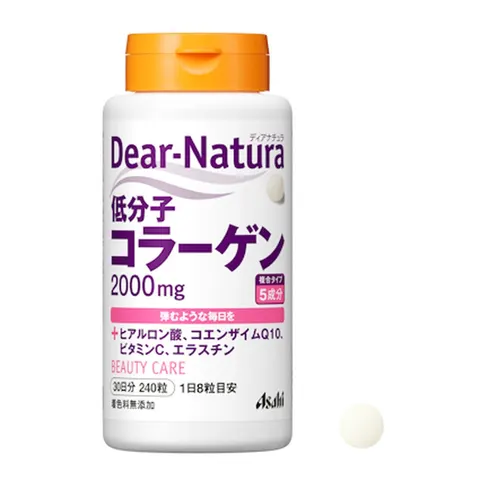
- Dear-Natura Low-Molecular Collagen: Collagen with Vitamin C, Hyaluronic Acid & CoQ10, 240 tablets (30 days), by Dear-Natura. The 8-tablet daily serving provides 2000 mg of low-molecular collagen and 80 mg of vitamin C. From 2370 yen.
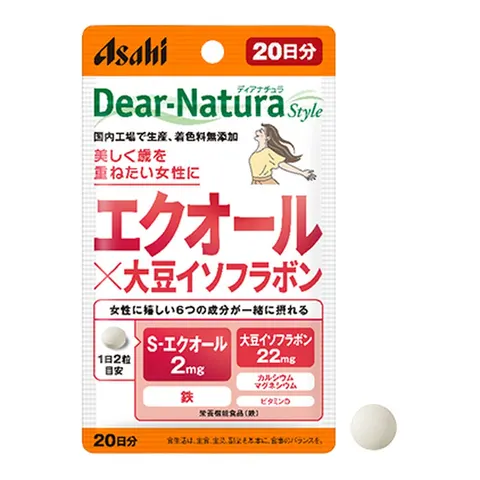
- Dear-Natura Equol & Soy Isoflavone with Iron, Vitamin D, Calcium & Magnesium: for youthful beauty, 40 tablets (20 days), by Dear-Natura. Each daily serving provides 2 mg of equol and 22 mg of soy isoflavones as aglycone. From 2750 yen.
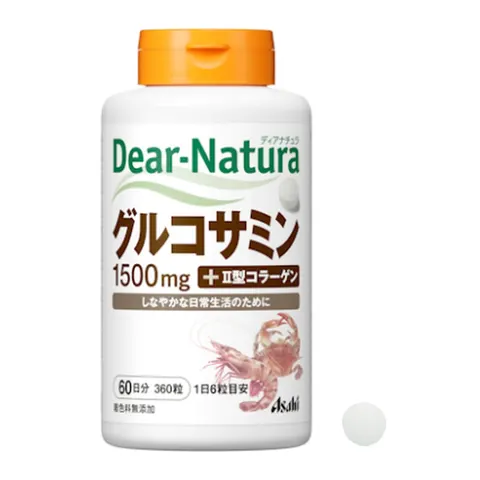
- Dear-Natura Glucosamine: glucosamine with type II collagen chicken cartilage extract, 360 tablets (60 days), by Dear-Natura. Six tablets a day give 1500 mg of glucosamine and 50 mg of cartilage extract containing type II collagen. From 3610 yen.
- Nature Made Calcium & Vitamin D, by Nature Made. Two tablets a day supply 600 mg of calcium from oyster shells, with no artificial colors or preservatives. From 1210 yen.
The full range sits in the supplements and vitamins section, and you can browse complete lines on the DHC and Dear-Natura brand pages.
Frequently asked questions
Can I take several Japanese supplements at once? Usually yes, but check for overlapping ingredients, particularly vitamin D, iron and zinc. If you take prescription medication, discuss the combination with a doctor first.
How long should a course run? Japanese packages are sized for 20, 30, 60 or 90 days. Manufacturers generally suggest assessing the result after 2-3 months of regular use.
Why are Japanese doses different from Western ones? Japanese formulas tend to be moderate and built as task-specific complexes rather than high-dose single ingredients. That is also why a daily serving is sometimes 6-8 tablets rather than one.
How long does delivery take? Shipping is from Tokyo, normally 3-10 business days before dispatch, then 5-14 days in transit by EMS. Every parcel is trackable.
Is there a minimum order? Yes, the minimum order is 22,000 yen in goods. Payment is by card through Stripe.
This article is for information only and is not medical advice. Consult a doctor before taking supplements.
This article is for information only and is not medical advice. Consult a doctor before taking supplements. Disclaimer & Health Notice
Products from this article
Dear-Natura
2,850JPY
Cashback +143 JPY
Dear-Natura
3,300JPY
Cashback +165 JPY
Dear-Natura
3,610JPY
Cashback +181 JPY
Related articles
- Shiseido The Collagen vs DHC vs Orihiro: Japanese Collagens Compared by Formula and Price
A practical comparison of three popular Japanese collagen brands by formula, format and cost per course, plus a simple method for working out the real price per day.
- Japanese Collagen Guide: Powder, Drink, Tablets or Jelly, and How to Take It
A practical guide to the four formats of Japanese collagen: powder, drinks, tablets and jelly sticks. How they differ in dose and cost per day, how to read a Japanese label, and how to take collagen as a course.